


Just Create - Cheetah Edition
Feb. 28th, 2026 09:33 pm![[personal profile]](https://www.dreamwidth.org/img/silk/identity/user.png) silvercat17 posting in
silvercat17 posting in ![[community profile]](https://www.dreamwidth.org/img/silk/identity/community.png) justcreate
justcreateWhat are you working on? What have you finished? What do you need encouragement on?
Are there any cool events or challenges happening that you want to hype?
What do you just want to talk about?
What have you been watching or reading?
Chores and other not-fun things count!
Remember to encourage other commenters and we have a discord where we can do work-alongs and chat, linked in the sticky.

Progress in the artificial "comprehension" of humor
Feb. 28th, 2026 01:38 pm![[syndicated profile]](https://www.dreamwidth.org/img/silk/identity/feed.png) no_swamp_coolers_feed
no_swamp_coolers_feedA minor side-line in my on-going investigations of how well or poorly LLM perform has been teasing them with jokes. Back when I started they were consistently abysmal at explaining why jokes (even very simple ones) were funny, though they could fairly consistently categorize them into wordplay, dark humor and similar bins. Some models would confidently assure me that I wrote the jokes wrong or that they didn't make sense.1
When the models started to get a little better (able to do a passable job on the easy ones) I added a couple of relatively subtle jokes to my list and those promptly stonkered the largest models I had access to.
Until today.
Aside
My 64 GB RAM framework laptop (which I had been using to run mid-sized models locally) was stolen last fall and I haven't replaced it. I was unwilling to send my questions to the AI companies lest they train to the test; so I didn't have access to large or mid-sized models to try for a while. Then ollama started offering cloud services. I think it is much less likely that queries made through that channel are making their way back to the model vendors (ollama says they don't and I suspect the massive social cost of getting caught would deter them even if they were inclined to cheat), so I started trying the big models on their servers from time to time.
Meanwhile, back on the ranch
The big open-weights GPT (gpt-oss:120b) is a really impressive model—I've been using it for a lot of chat tasks I might previously have lobbed at ChatGPT—but it still failed at both my "trick" joke questions. In fact it gave almost the same wrong answers as phi4, gemma3 and so on. Maybe the result of a effectively common training set?
On the other hand its answers to the technical question I ask models were much more like those the big (300B+ parameters) leading edge models were giving six months ago than the one mid-size models (30-70B parameters) were giving while I still had the framework. So I concluded that progress was being made on several fronts including coding2 and what I call "deep-search"3 but not necessarily on making connections for which its training set had few examples.
Today, after doing my regular Saturday chores, I updated my ollama and looked at the recent models. Hmmm ... I'd seen a youtube about this gfm model and they made a variety of brags that would be impressive if true. So I tried it. It aced one of my favorite, easyish-but-out-of-the-mainstream coding questions. Not screaming fast, but fast enough that running the model and looking through the output would be faster than my solving it by hand if I hadn't worked it out in advance to use as a key for the test.
I got ambitious and asked it about the jokes.
One of the prompts includes a couple of hints: it notes that the joke was current "in mid to late 2011" and asks for an explanation of the physics behind the humor. For a human not familiar with the episode that generated the joke it would probably require some web searches to answer, but I suspect most educated people would get there. Gfm-5 if the first model I've put this to that nailed it.
The other prompt is a little more blind. The model has to recognize the relationship between the scenario in the joke and a much more common, but generally not humorous, scenario in fiction. Then it has to examine the change in the joke's version and work out why people do a double take and then laugh or groan. The answer I got from the model was not great, but it was the first LLM answer to ID the underlying story fragment, ID the crucial change, and write that the change represent an unexpected or twist ending. Close enough for government work.
Wow. Just wow.
1 Why do LLMs hate Moby Pickle and Smokey the Grape, anyway? Parke Godwin may have been dead for ten years, but he still had the power to baffle GPT-4 with children's riddles.
2 Generally something that is vaguely like a common example problem but differs in significant ways. My prompt for writing a wavefront model (.obj and .mtl files) is enough like the usual example (a cube) that many models start hallucinating cube half-way through.
3 That is, digging into a topic and giving me a top-level explainer such as you might get from a academic colleague in a different department who knows you are smart but not familiar with the domain.
Monopoly 01.26 - Weekly Reminder, Week 7
Feb. 28th, 2026 07:38 pmprisca posting in fandom_empireWe already have 4 participants in the regular challenge. In the Team Challenge we have 1 participant for Team Alpha and 3 participants for Team Omega. Team Omega has already finished one line this week.
There are still about twenty hours until the end of week seven. Jump into the game and earn some points!
Remember your Joker Card if you don't like your prompts. For two tokens, you can roll the dice again!
If you have used your Joker Card to catch up with a previous week, you can still post up to two works for this week!
Post all your finished works atfandom_empire_workplace until Sunday, March 1, 18.00 UTC, but I will allow belated works until I've made the closing post. Countdown here.
There are still about twenty hours until the end of week seven. Jump into the game and earn some points!
Remember your Joker Card if you don't like your prompts. For two tokens, you can roll the dice again!
If you have used your Joker Card to catch up with a previous week, you can still post up to two works for this week!
Post all your finished works at
fandom_empire_workplace until Sunday, March 1, 18.00 UTC, but I will allow belated works until I've made the closing post. Countdown here.Multifandom: Be The First
Feb. 28th, 2026 06:16 pmgalerian_ash posting in fandomcalendarBe The First, the annual challenge to write for a fandom that has no fics, is now open for sign-ups!

• FAQ
• Sign-ups
• Fandom Promos
• AO3 Collection
• FAQ
• Sign-ups
• Fandom Promos
• AO3 Collection
Saturday Morning Breakfast Cereal - Fund
Feb. 28th, 2026 11:20 amsmbc_comics_feed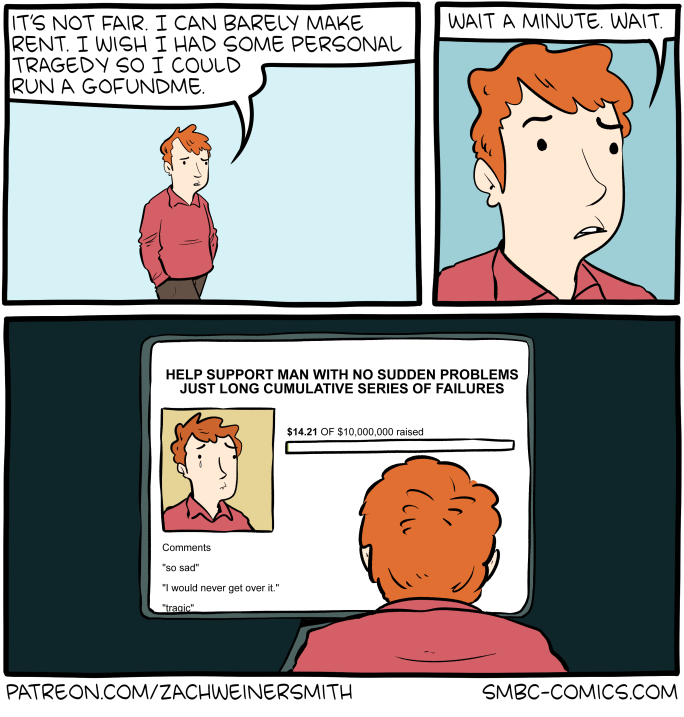
Click here to go see the bonus panel!
Hovertext:
I wonder if you could trick people into paying more in taxes by calling it traditional crowdfunding?
Today's News:

Drabblethon: Cruel Treatment & Maintenance: The Fantastic Journey
Feb. 28th, 2026 10:58 ambadly_knitted posting in small_fandomsTitle: Cruel Treatment
Fandom: The Fantastic Journey
Summary: Varian’s first encounter with people on the island was not a pleasant one.
Title: Maintenance
Fandom: The Fantastic Journey
Summary: The sonic energiser is Varian’s most valued possession.
( Maintenance... )

Adam Newbold
Feb. 28th, 2026 12:00 amusesthis_feed
Who are you, and what do you do?
I'm Adam Newbold, a web programmer living in Louisville. I run omg.lol, which someone once described as "a BBS adjusted for inflation," as well as Neatnik LLC, where I work on internet miscellany.
What do you use to get the job done?
Lots and lots of PHP, which I started learning nearly three decades ago and never stopped. I use the FastCGI Process Manager with Caddy to bring my silly scripts to life in the browser. If I have to use a database, it's SQLite or MariaDB, but I'd rather store JSON in a flatfile. For mail handling, I use Postfix with Postgrey, OpenDKIM, OpenDMARC, and OpenARC. For DNS, I use BIND 9. All of this is powered by Debian servers running on Hetzner hardware.
For programming and writing, I use Vim and Nova interchangeably. Boxy is my go-to tool for SVG and icon work, and Pixelmator Pro for sticker design and other graphics work. I use Glyphs to create and manage custom fonts (mostly icon fonts), and Wakamai Fondue for debugging those. I store all of my notes (mostly server build and service configuration stuff) in Obsidian and make heavy use of its wikilink syntax.
I have a small home office where I work, and it has just one computer: a 2022 Mac Studio which is still chugging along. That's what I use to do pretty much everything. I don't use laptops because I'm completely tied to my Happy Hacking Keyboard and Logitech MX Master 3 Mouse. If I have to do some kind of emergency computery work when I'm away from my office, I use an iPhone 16 with Prompt 3 to connect to stuff.
When away from screens, my main tools are Uniball Signo 1mm Pens and Kokuyo Campus B5 Dotted Notebooks.
What would be your dream setup?
Honestly? I would love to have a Rotom Phone.
Enjoy the interview? You can support independant publishing and help keep the site ad-free by buying me a coffee!
Intercepting messages inside IsDialogMessage, fine-tuning the message filter
Feb. 27th, 2026 03:00 pmoldnewthing2_feedLast time, we used a MSGF_ message filter to hook into the IsDialogMessage so that we had the option to grab the ESC before it gets turned into an IDCANCEL. There are some problems with our initial foray.
One is the problem of recursive dialogs. If the first dialog shows another copy of itself (for example, a certificate dialog showing a dialog for its parent certificate), then the thread-local variable gets overwritten, and the first dialog’s information is lost.
We could solve that by having each dialog remember the original value and restore it when the dialog dismisses. Alternatively, we could maintain an explicit stack of dialogs, pushing when a new dialog is created and popping when it is destroyed.
However, this fails to handle the case where the dialog is modeless. In that case, the two dialogs could be running concurrently rather than recursively. Instead of a stack, we really need a per-thread set of active dialogs.
Another thing to worry about is that if this code is put into a static library, and two components in the same thread both use that static library, then you have to be careful that the two copies of the library don’t conflict with each other.
I came up with this initial idea:
#define DIALOG_WANTS_ESC_PROP TEXT("DialogWantsEsc")

LRESULT CALLBACK DialogEscHookProc(int nCode, WPARAM wParam, LPARAM lParam)
{
    if (nCode == MSGF_DIALOGBOX) {
        auto msg = (MSG*)lParam;
        if (msg->message == WM_KEYDOWN &&
            msg->wParam == VK_ESCAPE) {
            auto hdlg = GetAncestor(msg->hwnd, GA_ROOT);
            auto customMessage = PtrToUint(GetProp(hdlg,
                                           DIALOG_WANTS_ESC_PROP));
            if (customMessage &&
                !(SendMessage(msg->hwnd, WM_GETDLGCODE,
                             msg->wParam, lParam) &
                         (DLGC_WANTALLKEYS | DLGC_WANTMESSAGE))) {
                return SendMessage(hdlg, customMessage, 0, lParam);
            }
        }
    }
    return CallNextHookEx(nullptr, nCode, wParam, lParam);
}
The idea here is that instead of having to manage a table of per-thread registrations, we just let dialogs self-register by setting the DIALOG_ property to the message number they want to receive when the user presses ESC.
If there are two copies of this hook installed, then the DialogEscHookProc is called twice. The first one sends the custom message and gets the dialog’s response, and returns it; it never passes the message down the hook chain. Therefore, the second and subsequent hooks never get to run, so we don’t have a problem of the custom message getting sent multiple times for the same call to IsDialogMessage.
This design has the advantage that multiple DLLs using this pattern can coexist because the first hook (whichever it is) does all the work for everybody.
An alternate, more complex, design would pass the call down the chain if the dialog box declined to handle the ESC key, in case some other hook wanted to do something special. The catch is that if there are multiple copies of this hook installed, each one will send the custom message to the dialog, which would be bad if the handler for the custom message had side effects like showing a confirmation dialog.
So we can add the rule that the custom message must be safe to call multiple times if it returns FALSE. This means that if it wants to display a confirmation dialog, it should always return TRUE even if the user cancels.
LRESULT CALLBACK DialogEscHookProc(int nCode, WPARAM wParam, LPARAM lParam)
{
    if (code == MSGF_DIALOGBOX) {
        auto msg = (MSG*)lParam;
        if (msg->message == WM_KEYDOWN &&
            msg->wParam == VK_ESCAPE) {
            auto hdlg = GetAncestor(msg->hwnd, GA_ROOT);
            auto customMessage = PtrToUInt(GetProp(hdlg,
                                           DIALOG_WANTS_ESC_PROP));
            if (customMessage &&
                !(SendMessage(msg->hwnd, WM_GETDLGCODE,
                             msg->wParam, msg) &
                         (DLGC_WANTALLKEYS | DLGC_WANTMESSAGE)) &&
                 SendMessage(hdlg, customMessage, 0, lParam)) {
                 return TRUE;
            }
        }
    }
    return CallNextHookEx(nullptr, nCode, wParam, lParam);
}
Or we can have the first hook leave a note for the other hooks that the message has already been handled and that they shouldn’t try to handle it again.
#define DIALOG_WANTS_ESC_PROP TEXT("DialogWantsEsc")
#define CURRENT_MESSAGE_PROP TEXT("DialogWantsEscCurrentMessage")

LRESULT CALLBACK DialogEscHookProc(int nCode, WPARAM wParam, LPARAM lParam)
{
    if (code == MSGF_DIALOGBOX) {
        auto msg = (MSG*)lParam;
        if (msg->message == WM_KEYDOWN &&
            msg->wParam == VK_ESCAPE) {
            auto hdlg = GetAncestor(msg->hwnd, GA_ROOT);
            auto customMessage = PtrToUInt(GetProp(hdlg,
                                           DIALOG_WANTS_ESC_PROP));
            if (customMessage) {
                auto previous = GetProp(hdlg, CURRENT_MESSAGE_PROP);
                if (previous != msg &&
                    !(SendMessage(msg->hwnd, WM_GETDLGCODE,
                                 msg->wParam, msg) &
                             (DLGC_WANTALLKEYS | DLGC_WANTMESSAGE))) {
                    return SendMessage(hdlg, customMessage, 0, lParam);
                }
                SetProp(hdlg, CURRENT_MESSAGE_PROP, msg);
                auto result = CallNextHookEx(nullptr, nCode, wParam, lParam);
                SetProp(hdlg, CURRENT_MESSAGE_PROP, previous);
                return result;
            }
        }
    }
    return CallNextHookEx(nullptr, nCode, wParam, lParam);
}
The first hook will send the message to the dialog. and if the dialog declines to handle it, it passes the messages to the other hooks, but setes the “current message” property to the message that was already handled, so that other hooks won’t try to handle it again.
The last part of the puzzle is installing the hook. Since we are assuming that we cannot alter the dialog loop, the hook has to be installed by the dialog itself.
Let’s assume that this dialog box already allocates other dialog state, so we can add the hook handle to the state structure.
struct DIALOGSTATE
{
    wil::unique_hhook escapeHook;
    ⟦ other stuff ⟧
};

// each dialog can choose its own custom message
#define DM_ESCPRESSED (WM_USER+1000)

INT_PTR CALLBACK DialogProc(HWND hdlg, UINT message, WPARAM wParam, LPARAM lParam)
{
    switch (message) {
    case WM_INITDIALOG:
        {
            DIALOGSTATE* state = new(std:nothrow) DIALOGSTATE();
            if (!state) { EndDialog(hdlg, -1); return FALSE; }
            SetWindowLongPtr(hdlg, DWLP_USER, (LONG_PTR)state);
            state->escapeHook.reset(SetWindowsHookEx(WM_MSGFILTER,
                             DialogEscHookProc,
                             nullptr, GetCurrentThreadId()));
            SetProp(hdlg, DIALOG_WANTS_ESC_PROP,
                    IntToPtr(DM_ESCPRESSED));
            ⟦ other dialog initialization as before ⟧
            ⟦ ending with "return (whatever)" ⟧
        }

    case DM_ESCPRESSED:
        if (⟦ we want to process the ESC key ourselves ⟧) {
            ⟦ do custom ESC key processing ⟧
            SetWindowLongPtr(hdlg, DWLP_MSGRESULT, TRUE);
            return TRUE;
        }
        break;

    case WM_DESTROY:
        {
            auto state = (DLGSTATE*)GetWindowLongPtr(hdlg, DWLP_USER);
            delete state;
        }
        break;

    ⟦ handle other messages ⟧
    }
    return FALSE;
}
The dialog installs the hook when it is created and removes it when it is destroyed. The hook has become an implementation detail of the dialog.
Now, I don’t recommend doing all this. Better is to just treat with the ESC like any other press of the (possibly imaginary) Cancel button. One of the few scenarios I can think of where this could be useful is if you want to display an extra confimation for the Close button (since its meaning is potentially ambiguous). This is still nonstandard, but at least it’s not too nonstandard. And for that, you can just intercept WM_CLOSE instead of trying to intercept the ESC. Intercepting the ESC was really just an excuse to show off message filters, which tend to be unappreciated.
The post Intercepting messages inside <CODE>IsDialogMessage</CODE>, fine-tuning the message filter appeared first on The Old New Thing.